Watching AI write, organize information, and even suggest new ideas naturally raises a question: will the role of humans keep shrinking? If AI can do our work faster, will there be fewer reasons for an employer to need us? These concerns are not excessive. We are already seeing changes such as one person using AI to handle work that previously required three, while it remains unclear whether enough new jobs will emerge to replace those that disappear.
Yet using LLM-generated sentences in actual work has also led me to a somewhat different thought. In document writing, getting a draft has become faster, but I have found that substantial portions still need revision before I can use them (I expect the same to apply in related areas such as images and video). The work goes beyond shortening sentences or replacing awkward expressions. Some claims are stronger than their evidence supports; some paragraphs read smoothly but omit the very explanation they need.
Perhaps the difference will increasingly lie in recognizing what is missing from an AI-generated result, explaining why it needs revision, and actually turning it into something better. Could having that ability affect the work we are entrusted with, or even our ability to keep our jobs? This is not yet a conclusion on which to base predictions about future employment. It is, however, a thought I keep returning to as I revise AI-generated text.
Education is a particular concern. When AI solves assignments, opportunities to engage in complex thinking and sustained effort tend to diminish. Personally, I think that even careful, diligent use of AI differs, in the amount of knowledge absorbed and how long it stays with us, from starting with nothing and building an understanding by comparing all sorts of books in a library.
I also suspect that this difference will affect our ability to assess the validity and usefulness of AI-generated work. For generations that begin using AI extensively, it may become even harder for the proportion of people with strong competitive skills to rise above that of earlier generations. Of course, I am talking about a broad tendency, and I believe it is something that individual effort can overcome.
A Paper That Helped Lay the Foundations of the LLM Era
One paper that invariably comes up when tracing this change is Vaswani and colleagues’ 2017 Attention Is All You Need. Among the most widely cited papers in AI, it introduced the Transformer architecture underlying many of today’s LLMs. Exact citation counts and rankings vary by service and date.
Even the title is striking. If a student proposed that title for a paper, their professor might scold them before it ever reached a journal.
The paper’s main experiments concerned machine translation. Instead of a recurrent structure that passed information along sequentially, it proposed an architecture centered on attention. Making parallel processing easier during training was another important change. This single paper did not deliver all of today’s AI capabilities, but it provided an important foundation for subsequent advances in model scale, data, and training methods.
Language models subsequently expanded beyond translation into writing, question answering, summarization, and code generation. Language Models are Few-Shot Learners, the paper on GPT-3, is a representative study showing how instructions and examples in the input can enable a model to perform various tasks without retraining its weights. It forms part of the path toward today’s practice of requesting work in natural language and receiving a result.
Work can now begin with sentences AI produces in a few seconds, alongside sentences someone writes from scratch. For me, the more immediate question is what comes next: how much of that quickly generated text should I trust, and where should I start revising it?
Why Does Smooth Writing Still Need So Much Revision?
An LLM’s answer often looks well written at first. The relevant terminology is there, the paragraphs are organized, and a summary appears at the end. Problems emerge when I reread it with my actual work in mind. Essential conditions are missing, or something merely possible is presented as an established fact.
At least three aspects need to be distinguished.
| Aspect | Question to Ask | Example of a Needed Revision |
|---|---|---|
| Expression | Does it communicate accurately for this audience and purpose? | Abstract modifiers obscure what will actually be done. |
| Evidence and logic | Is the claim supported, and does the conclusion follow from the premises? | Two benefits are listed, followed by a conclusion that both can be achieved together. |
| Conditions of application | Does it hold under the conditions of this task and workplace? | Results from different materials or test conditions are applied without adjustment. |
However polished the writing, its reasoning may have gaps. A fact can be correct yet inapplicable to the problem at hand. Conversely, a rough sentence that identifies important conditions and limitations may be more useful in practice.
Producing several good expressions and choosing the most appropriate one for the situation are also different abilities. “It improves,” “it may improve,” and “whether it improves needs to be tested” use similar vocabulary, but carry very different levels of commitment in a research document. Choosing among them requires a feel for language as well as judgment about the strength of the evidence.
Gaps That Better Transitions Cannot Fill
Consider an example from research on natural-fiber composites. The following is an invented sentence for illustration, rather than a quotation from an actual experiment or a particular model’s response.
Strengthening the bond between natural fibers and resin improves mechanical performance. Therefore, recyclability also improves, enabling a sustainable composite material.
At first glance, this might look suitable for a research proposal. But it does not explain why stronger interfacial bonding would improve recyclability. Depending on how the interface is strengthened, reprocessing may become harder. The assessment also changes depending on whether recycling means melt reprocessing or separating and recovering the fibers and resin. Mechanical performance, too, depends on more than the interface alone.
Replacing “therefore” with “also” might make the sentence feel a little less awkward. It would still provide no technical basis for achieving the two goals together. The necessary revision goes deeper than the transition word. We first need to specify the materials and interface treatment, the intended recycling route, and whether the two goals might conflict.
If the evidence is not yet available, wording like this would better fit the stage of the research:
This study explores conditions that could improve interfacial bonding between natural fibers and resin while maintaining reprocessability. Mechanical performance will be compared before and after interface treatment, alongside changes in properties following repeated reprocessing. Whether both goals can be achieved together must be established experimentally.
This revision does not prove that a particular technology is feasible. It does, however, distinguish the research objective, the method of checking it, and the remaining uncertainty, rather than presenting an unverified outcome as an achievement. An actual document would need more specific test items and criteria suited to the materials and process.
This is part of what I mean by being good at revision: recognizing a missing mechanism, narrowing a claim to what can be supported, and proposing what to check next. More elegant prose alone cannot solve the problem.
What Does Attention Connect, and What Does It Guarantee?
Understanding this distinction calls for a closer look at how LLMs work. Self-attention, a central component of the Transformer, updates each token’s representation by calculating how much it should draw on information from other tokens in context. Tokens are the units a model uses to process text; a token may be a whole word or part of one.
The original paper gives the basic attention formula as follows:
Learned weights transform input representations into queries (), keys (), and values (). Queries and keys determine the attention weights, which are then used to combine information from the values. Here, is the key dimension. Relationships among multiple tokens can be processed through matrix operations. A typical autoregressive LLM, however, cannot see tokens that have not yet been generated and produces its answer one token at a time.
A high attention weight does not certify that the corresponding information is true. Attention combines information; it does not directly guarantee the validity of an argument or the truth of an experimental result. A trained model as a whole can certainly use this architecture to perform useful reasoning. Still, being able to calculate relationships within a context does not mean that the claims in that context have been verified.
Typical autoregressive language models are pretrained to predict the next token from the preceding context. The probability that an expression will come next is not the same as the probability that its scientific claim is true. In producing a plausible continuation, a model can also give a convincing account of a causal relationship that has not been established.
More Data Does Not Remove the Need to Read Conditions and Uncertainty
The content and composition of training data influence the relationships and expressions a model learns. But neither the amount nor the accuracy of data alone determines the quality of an answer. Training objectives, model architecture, post-training, the supplied context, and tools all play a part. Factual accuracy and writing appropriately for a reader must also be assessed separately.
Conflicting research findings do not necessarily mean that one is wrong. The same additive can produce different property changes depending on the matrix, concentration, dispersion, interface treatment, and specimen conditions. Tests of natural fibers themselves must also be distinguished from tests of composites containing those fibers. Removing these conditions and summarizing everything as “adding it improves performance” makes the sentence shorter while making the information less accurate.
What I want to check in an AI summary, then, is more than its conclusion. It should retain the source, the conditions under which the finding held, and whether it applies to the present subject. Revision needs to preserve clues that explain differences, rather than forcing different results into one smooth story.
Leaving unknowns unresolved matters, too. A complete answer is not necessarily a complete argument. Tomani and colleagues’ study on abstention showed that withholding some answers based on uncertainty can improve reliability in question-answering tasks. That does not guarantee the same effect in every kind of work, but an LLM clearly does not always have to fill in an answer to the end.
In practice, I think it is better to ask the model to reveal what information is missing than to cover the gap with more natural prose. “We cannot judge this until this condition has been checked” can be more useful for deciding the next step than “it is possible.”
What Difference Does Human Experience Make?
A single rare experience can substantially change a person’s later judgment. Imagine a process that has run successfully many times, until one unexpected episode of thermal decomposition damages the equipment. This is another hypothetical example, but a researcher who experienced it would probably consider more than the frequency of failure when reviewing a similar process. They might recall the conditions, missed warning signs, and extent of the damage, and demand additional checks beforehand.
What matters is why it happened, under what conditions it could happen again, and what would be lost if it failed. Even one observation can justify changing a judgment if it exposes a condition the existing explanation missed. For a person, that experience can connect recorded facts with emotions, goals, and responsibility.
This does not mean that people are always more accurate. We may overgeneralize from a memorable accident or miss a new risk because past successes have become familiar. AI can also take rare events into account through examples in its input, external records, or further training. The in-context learning discussed earlier is itself a way of using examples. It is therefore inaccurate to say that people can learn from a single experience while AI cannot.
There may also be similarities between humans and AI in how we construct sentences. If humans choose words and expressions that feel more natural or appropriate to the current context based on what they have read, heard, and said throughout their lives, there is room to understand this as probabilistic selection shaped by experience. Such a similarity does not mean that the human brain and an LLM share the same detailed operating mechanisms.
The difference I feel more strongly at work concerns where the context needed for a judgment resides, and who lives with its consequences. People on site may know circumstances never written into a document, and they bear the consequences when a bad decision is put into practice. A model asked only to produce text, without being given that context, has difficulty accounting for it adequately. Even when an experienced person participates in a review, that participation only matters if they have the information and authority needed to understand the content and change the decision.
The standards for exploring ideas and for operating equipment cannot be the same. In the former, we can explore possibilities supported by limited evidence; in the latter, the cost of failure may call for stricter checks. This is better understood as setting the required level of evidence for the situation than as a simple division between intuitive humans and probabilistic AI. We also need to give AI explicit goals, risks, and decision criteria, and check whether it follows them.
What Will It Mean to Be Good at Revision?
To put these thoughts into practice, I would like to review work in the following order. This is a proposed workflow drawn from the discussion above; I am not claiming that its effectiveness has been experimentally verified.
- State the purpose and conditions first. Identify who will read the document, what decision it will inform, the available sources, and the constraints on site. An exploratory note and a final report allow different wording even when discussing the same idea.
- Match claims with evidence. Check the source and conditions behind each important claim, distinguishing established facts, hypotheses to test, and insufficient evidence. Even when a source is given, read the original to see whether it actually supports the claim.
- Look for gaps between sentences. Check whether the conclusion after “therefore” follows from the preceding evidence, and whether alternative explanations or counterexamples exist. If a mechanism is missing, leave that part unresolved and identify the information or experiments needed.
- Apply the decision criteria, then refine the wording. Review high-cost failures and rare failure cases separately, and match the certainty of the final wording to the evidence. Then revise the order and language so the reader can understand it easily.
We can also ask AI to “classify each causal link as an established fact, a hypothesis to test, or insufficient evidence; leave unsupported connections unresolved and propose the necessary verification.” But even a model’s label of “fact” needs checking. AI self-review does not replace actual sources or experiments.
Doing this kind of revision ultimately requires understanding the subject. A feeling that a sentence is awkward is not enough to explain what is missing. Domain knowledge and experience, an understanding of the reader’s situation, and the ability to admit what we do not know and find ways to check it all matter. This is why I feel that existing expertise and continued learning remain part of the ability to use AI.
Can That Ability Protect Our Place at Work?
The idea that skilled revisers will be needed must be distinguished from the prediction that this need will preserve today’s number of jobs. Review tools will improve, and one person working with AI may be able to handle more work. Developing expertise does not necessarily protect an individual from staff reductions or organizational change. It is difficult to present revision as a permanent human advantage.
Even so, in my own work, someone who can recognize the shortcomings of LLM-generated text may produce a different result from someone who accepts it unchanged. Being able to decide which claim to delete, which condition to ask about, and where to postpone a conclusion could change the work a person is entrusted with. I think that difference may be one factor in maintaining one’s role and position.
What is more frightening is the prospect of AI advancing beyond drafting to a point where it can adequately replace the review and revision people now perform afterward. What if AI can find missing conditions, cross-check evidence, and correct faulty causal reasoning more accurately and cheaply? There is no guarantee that the abilities we currently see as reasons to need humans will remain ours to exercise.
The recent pace of change makes it difficult to dismiss this as a distant possibility. According to an October 2026 announcement record compiled in the OpenAI Developer Community, OpenAI’s Tibo Sottiaux announced that, over the next 28 days, the company would either deliver a meaningful improvement relevant to most Codex and Work users each day or reset usage limits on days without one. This was not a promise to release a new model every day, but a commitment to improvements on a daily schedule makes the pace of product change tangible. Of course, the frequency of updates does not itself mean better performance in every task. Still, it is difficult to take comfort in today’s limitations as a reason to believe that human roles will last.
This raises another question. If the AI I experience still needs so much revision, why do some of the people who have researched and developed it describe such serious risks? The CAIS statement on AI risk, signed by Geoffrey Hinton, Yoshua Bengio, and others, argues that mitigating the risk of human extinction from AI should be a global priority. There is a considerable distance between such warnings and the capabilities I encounter in everyday use.
Andrej Karpathy’s “funnel” offers a way to think about that gap. A CellCog explainer quoting his October 11, 2026 post on X summarizes four tiers of AI access and use:
| Tier | Experience of AI Access and Use | Estimated Population |
|---|---|---|
| 1 | People who have barely encountered LLMs | About 6 billion |
| 2 | Occasional users of free chatbots for search or writing help | About 1–2 billion |
| 3 | Professionals using frontier models and agents for work such as math and coding | About 20 million |
| 4 | People with access to frontier AI systems inside research labs | About 5,000 |
These are Karpathy’s rough estimates, rather than survey findings. The tiers are not sequential stages of AI development or grades of human ability. What interests me is that people discussing the same “AI” at the same moment may have encountered very different systems and entrusted them with very different work.
Perhaps some people in the fourth tier have felt fear after seeing capabilities or signs of change I have not yet encountered. What still looks to me like a tool needing substantial revision may look to them like something that could outpace even human review and comprehension. But this is my speculation as I listen to their warnings. The funnel alone cannot establish who saw what and became afraid, or how dangerous an internal system actually is. Just as my own experience is insufficient grounds to dismiss a warning, an insider’s warning does not by itself prove a danger. If we experience different levels of AI capability, how can we build public evidence that allows us to assess those capabilities and risks together?
For now, I think I need to keep practicing: read the answer AI provides, find the missing conditions, and rewrite it to fit the evidence. But I cannot say that this practice guarantees my future place at work. As I ask whether I can explain why my revision is better, I also need to consider what I could take on when AI can provide that explanation and revision as well. If AI comes to handle even human review and revision, what role will be left for us? These days, that question stays with me, too.
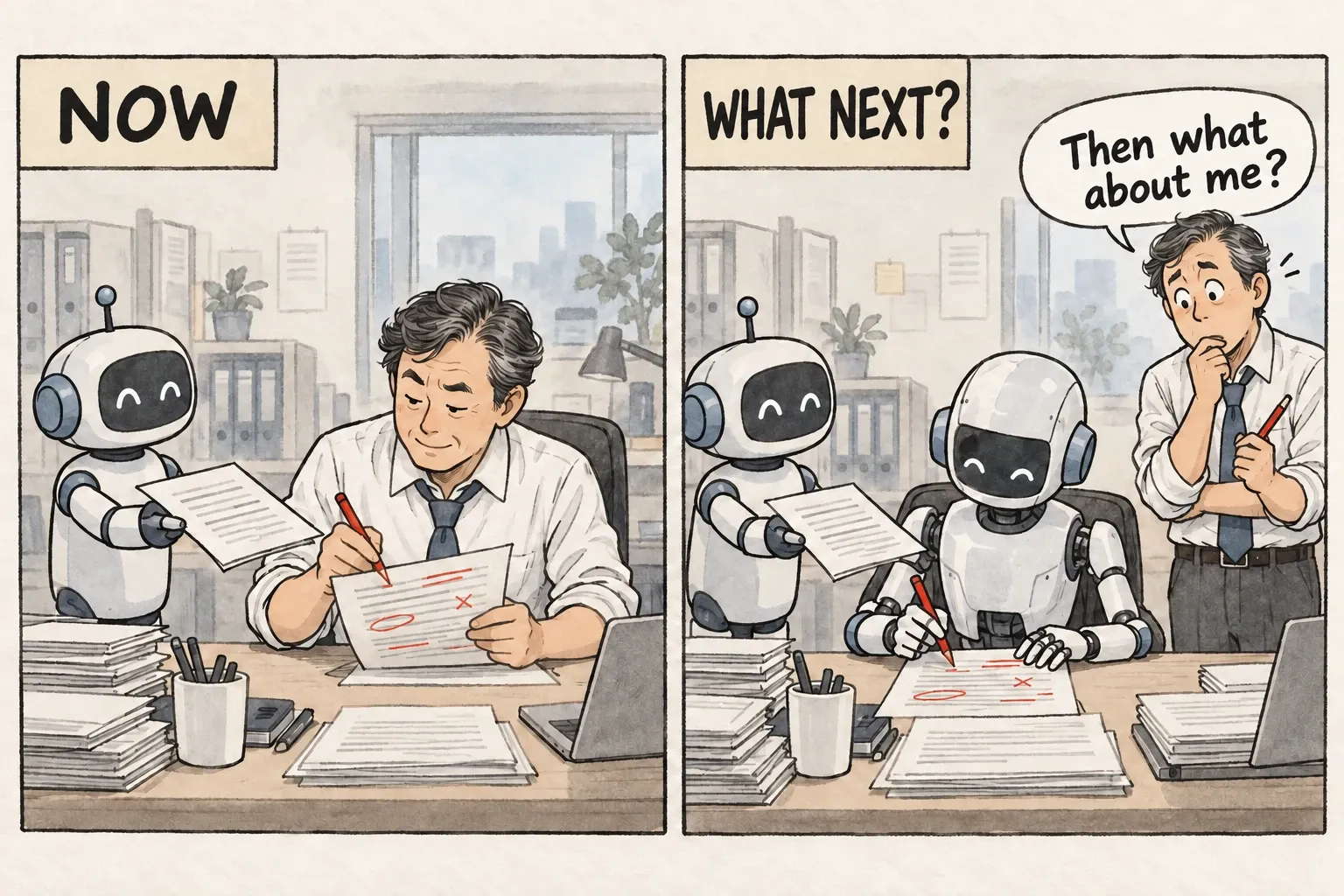
If AI takes over the seat where we once revised its drafts, what will we take on? An AI-generated editorial cartoon imagining a possible future.
References
- Vaswani, A. et al. (2017). Attention Is All You Need. The original paper introducing the Transformer and its attention architecture.
- Brown, T. B. et al. (2020). Language Models are Few-Shot Learners. A study of GPT-3’s in-context learning and performance across diverse tasks.
- Tomani, C. et al. (2024). Uncertainty-Based Abstention in LLMs Improves Safety and Reduces Hallucinations. A study evaluating uncertainty-based abstention in question-answering tasks.